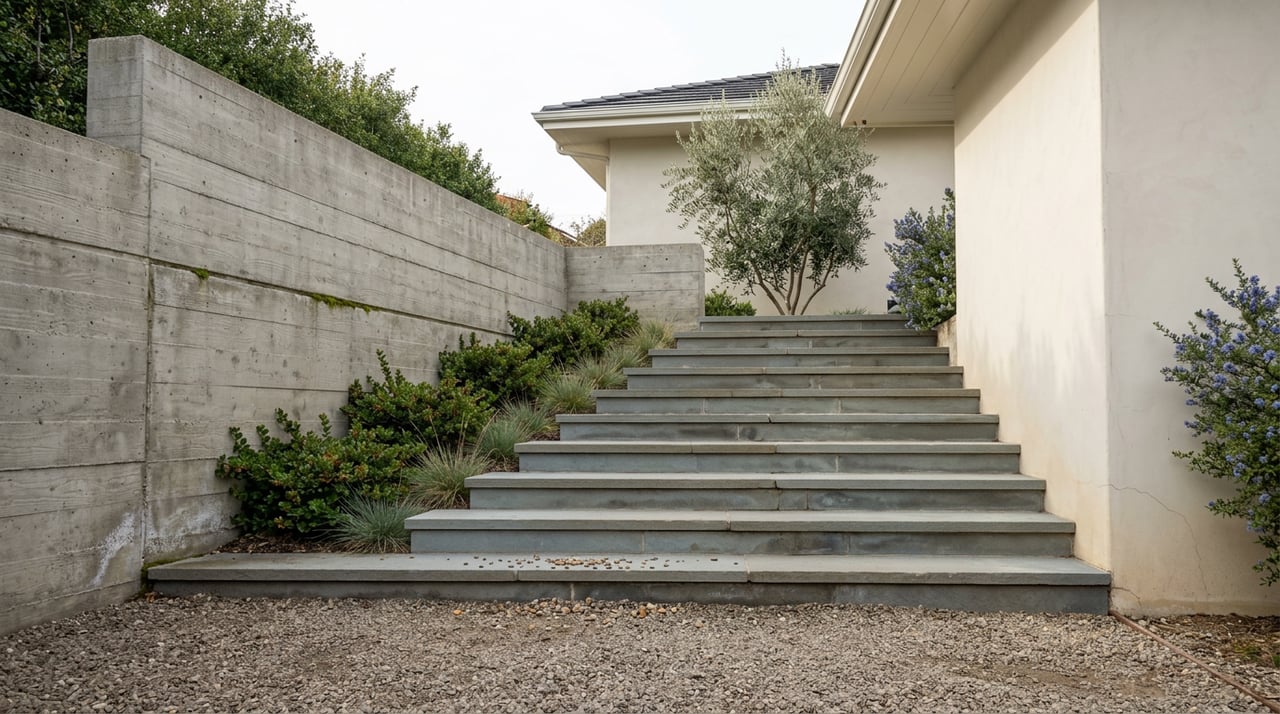
Two San Carlos listings can sit in the same price band, the same school-service area, even the same square footage, and still be two entirely different construction projects the moment a buyer starts planning an addition. One sits on a flat, downtown-adjacent lot in White Oaks. The other climbs into Cordilleras Heights, where the lots get bigger and the grade gets steeper. A comp sheet will not tell you which one you're looking at. The city's own slope formula will.
San Carlos measures average slope with a specific equation, and any lot that comes out at 20 percent or greater falls into the Hillside Overlay District, a zoning layer defined in Chapter 18.12 of the municipal code. Cross that threshold and a straightforward remodel picks up a slope survey, a lower building height ceiling, and, more often than not, a soils report before the city will sign off on plans. Stay under it and you're working within the standard residential district rules. The line isn't a neighborhood name. It's a number the city calculates parcel by parcel.
What the slope line actually changes
According to the City of San Carlos Planning Application FAQ, the Hillside Overlay District caps building height at 28 feet under the base residential standard, with an overall ceiling of 35 feet, tighter than what a flatter lot in the same zoning district gets. That alone reshapes what a two-story addition looks like on paper before a contractor ever bids the job.
Soil is where the bigger surprise lives, and it cuts both ways. According to the City of San Carlos Building Permits page, the building department sets a baseline soil bearing value of 1,500 pounds per square foot. Come in under that, anywhere in the city, and you need a soils report and likely a revised foundation design regardless of which side of the slope line you're on. The catch is that flatland lots aren't automatically the easy build. Areas near the bay carry bay mud and sandy soil, both known for poor bearing capacity under piles and walls. The foothills bring granitic soil and steeper grading rules instead. Different problem, same outcome: a geotechnical engineer gets involved before the building permit does.
Frost depth adds a second layer that has nothing to do with earthquakes or lot value. The coastal flatlands see close to zero frost penetration. The eastern foothills see 12 to 30 inches, which changes how deep a footing has to go to meet code. A buyer comparing renovation costs between a flatland fixer and a hillside fixer of the same square footage is, in effect, comparing two different foundation systems.
There's a third geographic layer worth knowing before an offer goes in: the city's Wildland-Urban Interface map, which applies to the area south of San Carlos Avenue and west of Alameda de las Pulgas. Properties inside that mapped zone carry their own defensible-space and construction standards on top of whatever the Hillside Overlay or soil rules already require.
| Flatland lots | Hillside Overlay lots (20%+ average slope) | |
|---|---|---|
| Typical soil concern | Bay mud or sandy soil, poor bearing in places | Granitic soil on steep grade |
| Frost depth | Near zero | 12 to 30 inches |
| Height limit | Standard RS district cap | 28 ft district cap, 35 ft overall |
| Extra review triggered | Soils report if bearing value is under 1,500 psf | Slope survey, soils report, possible WUI defensible-space rules |
The ceiling that applies no matter which side you're on
Even a lot that clears every slope and soil test still runs into a citywide limit on how big the house can get. In November 2018, the San Carlos City Council adopted a floor-area formula, as described in the city's Single-Family House (Size) Study, that caps additions regardless of location: for lots up to 7,500 square feet, maximum floor area is the larger of 1,100 square feet plus 35 percent of lot area, or 50 percent of lot area. Larger lots are capped at 50 percent of lot area outright.
That rule didn't appear out of nowhere. It came out of two years of public process, a resident-driven Single-Family House Advisory Committee, input from Good Growth San Carlos, a volunteer group focused specifically on reducing house bulk, and more than 150 residents who showed up to a community open house to weigh in on how much house a lot should be allowed to carry. The council was explicit that there was no single number that would satisfy everyone. What came out the other side was a formula, and it still governs every addition proposal in the city today, whether the lot sits flat downtown or climbs a hillside.
San Carlos also zones its single-family neighborhoods by density per net acre, RS-3 and RS-6, rather than the more familiar minimum-lot-size R-1 approach used elsewhere on the Peninsula. It's a small structural difference, but it means the usual shorthand buyers bring from other cities doesn't map cleanly onto how San Carlos actually regulates a lot.
Why the timing makes this expensive to discover late
None of this is theoretical friction. San Carlos closed the first quarter of 2026 with its highest first-quarter sale prices on record, and homes are moving fast enough that there's little room to absorb a permitting surprise mid-contract. County MLS data tracked through the local association put the March 2026 single-family median sale price at $3,167,500, with homes averaging 20 days on market and closing at 105 percent of list price, a jump of roughly 19.5 percent over the full 2025 annual median of $2,650,000. Twenty-four single-family homes closed in San Carlos that month alone, totaling close to $81 million in volume.
The first half of 2026 kept that pace. Two San Carlos sales cleared $6 million, and the market pushed prices back toward the highs last seen in 2021 and 2022. What's easy to miss is that this isn't a cash-buyer story. Of the roughly 140 homes that changed hands through the first half of 2026, only 17 percent were all-cash purchases, barely up from 15.6 percent for all of 2025. Most buyers in this market are financing, which means most buyers are also working within lender timelines and appraisal contingencies that don't flex well if a soils report or a slope survey shows up as a surprise requirement three weeks into escrow.
That's the real cost of treating San Carlos as one undifferentiated market. A buyer who assumes a hillside lot in Cordilleras Heights carries the same renovation math as a flatland lot in White Oaks isn't just wrong about square footage. They're wrong about the foundation, the height limit, and potentially the entire scope of what the city will let them build.
What to actually check before you write an offer
- Ask for the parcel's average slope calculation, or run it yourself using the city's GIS zoning map, before assuming a lot falls outside the Hillside Overlay District.
- Confirm whether the lot falls within the Wildland-Urban Interface map, south of San Carlos Avenue and west of Alameda de las Pulgas, since that triggers separate defensible-space standards.
- Request the soil hazard zone designation for the parcel. A bearing value under 1,500 psf means a soils report before permitting, on either side of the slope line.
- Run the 2018 floor-area formula against the actual lot size before assuming an addition is buildable at the scope you're picturing.
- Ask how deep local frost penetration runs for that specific parcel, since foundation depth requirements differ meaningfully between the flatlands and the foothills.
A few questions worth asking directly
Does every hillside lot in San Carlos need a soils report? Not automatically, but any lot in the Hillside Overlay District is more likely to trigger one given the grading and foundation standards tied to steeper slopes, and the city's planning director can require a slope survey to confirm whether the overlay even applies.
Is a flatland lot the easier build by default? Not necessarily. Soil bearing value, not location, is what actually triggers a soils report citywide, and some flatland parcels near the bay carry bay mud that performs worse under a foundation than a well-drained hillside lot would.
How do I find my lot's average slope before I call a contractor? The city publishes the formula and offers a GIS-based zoning lookup that returns parcel-specific information, including whether a property falls inside the Hillside Overlay District, directly from an address or parcel number.
San Carlos rewards buyers and sellers who do this homework before the inspection period starts, not during it. If you're weighing a renovation project against a move-in-ready flatland home, or trying to figure out what a hillside lot in Cordilleras Heights will actually cost to build on, Travis Conte can walk the specific parcel data with you before you're under contract, not after.
Let's Connect.
This article is general information, not legal, tax or financial advice. Consult a qualified professional about your situation.